Technical Sharing
2026/09/21
How Industrial Automation Systems Improve Productivity?
21
2026/09/
Manufacturers are under constant pressure to produce more while controlling labor costs, shortening delivery times, supporting more product variants, and maintaining consistent quality. These pressures make productivity a system-level challenge rather than a simple question of how quickly one machine can operate.
Industrial automation can improve productivity by coordinating material movement, production processes, inspection, equipment control, and production data. The goal is not simply to make individual operations faster. A productive automated system reduces unnecessary movement and waiting, stabilizes cycle times, limits process variation, supports flexible production, and gives manufacturers clearer visibility into what is happening on the production floor.
What Is Industrial Automation?
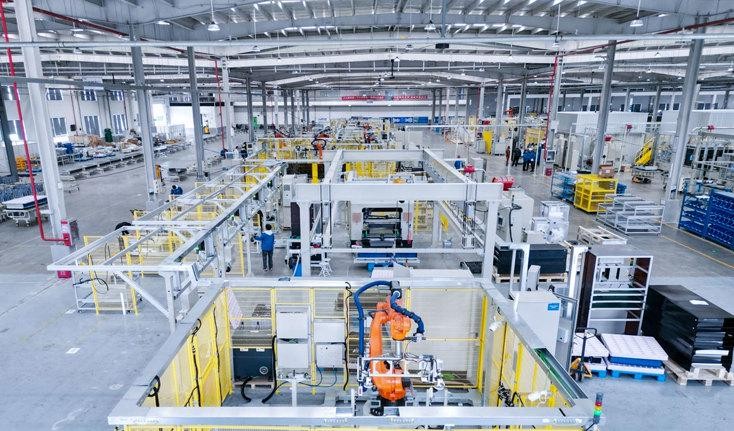
Industrial automation is the coordinated use of machines, control systems, sensors, software, automated handling, and production equipment to perform manufacturing processes with limited manual intervention.
Automation therefore means more than installing robots. A complete production system may combine automated assembly, welding, fastening, inspection, testing, conveyors, flexible transport, programmable controls, and production management software.
| Automation layer | Productivity role |
| Process equipment | Performs repetitive production tasks |
| Material handling | Moves products between operations |
| Control systems | Coordinates machines and process sequences |
| Inspection and testing | Detects quality issues during production |
| Production software | Collects and uses manufacturing data |
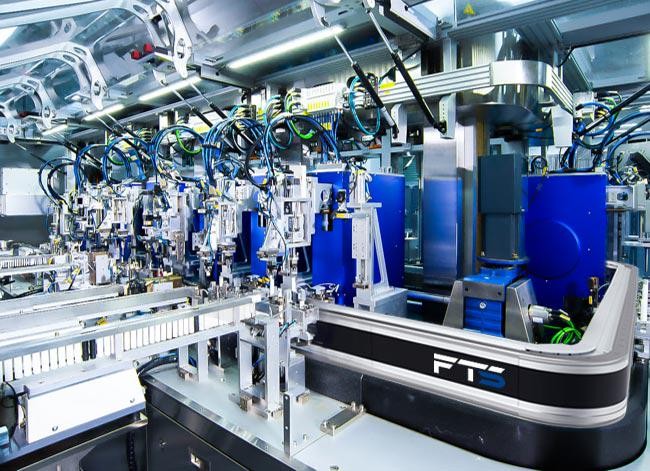
For example, FHS's Flexible Transport System (FTS) uses linear motor technology, movers, control systems, and guide rails to provide high-speed and precise material transport. Depending on the FTS model, the system can reach speeds of up to 5 m/s, while positioning accuracy can reach ±0.01 mm or ±0.03 mm on specific series.
This illustrates an important principle: manufacturers evaluating industrial automation should consider how well equipment, material flow, and production controls work together rather than counting the number of automated machines.
How Does Industrial Automation Improve Manufacturing Productivity?
Industrial automation improves productivity through several connected mechanisms, from cycle-time control to production visibility.
How Does Automation Increase Production Speed and Throughput?
Automation increases throughput by stabilizing cycle times and coordinating production stations and material movement.
A fast machine cannot deliver high line productivity if materials wait between stations or workers must repeatedly reposition components. Automated transport and synchronized processes can reduce these interruptions.
FHS's module stacking application, for example, uses magnetic-levitation transport and automated loading. The production line is specified at 72 ppm, while its design can save 50% of the production-line footprint. The system can also automatically adjust mover positions according to workpiece size, supporting faster changeovers.
How Does Automation Reduce Manual Handling and Repetitive Work?
Automation reduces dependence on repetitive manual handling by taking over standardized operations such as loading, unloading, positioning, fastening, and material transfer.
This does not necessarily mean replacing workers. Instead, it can move employees away from highly repetitive physical tasks toward supervision, maintenance, quality management, and process improvement.
A recent FHS energy-storage application demonstrates the potential effect on cycle time. In battery-module steel-band fitting, the reported operation time decreases from 90 seconds manually to 45 seconds with semi-automation and 26 seconds with full automation. The comparison shows how automating a specific bottleneck can directly affect production capacity.
How Does Automation Improve Consistency and Product Quality?
Automation improves consistency by controlling repetitive movements, positioning, process parameters, and inspection steps more systematically.
Manual processes can vary because of fatigue, operator technique, positioning differences, or missed inspection steps. Automated systems can incorporate technologies such as vision inspection, electrical testing, leak testing, torque control, and process monitoring.
For instance, FHS's energy-storage cabinet production line integrates automated equipment with a Manufacturing Execution System (MES), while its process includes tightening traceability, testing, and automated handling of OK and NG cabinets. The published specification is 10 minutes per cabinet, with a 99.5% product excellence rate and a failure rate below 2%.
The productivity benefit therefore includes more than output. Reducing rework, inconsistent processes, and quality-related interruptions also protects usable production capacity.
How Can Automation Reduce Downtime and Production Bottlenecks?
Automation reduces bottlenecks when production equipment, transport, controls, and monitoring are designed as one coordinated system.
A production line can lose capacity even when individual machines operate quickly. Waiting for material, repeated positioning, equipment faults, and difficult commissioning can all interrupt the overall flow.
Technologies such as programmable control, production monitoring, virtual simulation and debugging, and digital twin systems can help manufacturers identify process problems earlier and improve system coordination. FHS lists these technologies among its manufacturing automation capabilities, alongside PLC control, vision systems, MES software, and flexible transport technology.
How Does Automation Support Flexible Production and Faster Changeovers?
Automation supports flexibility by allowing equipment, tooling, transport, and control logic to adapt to different products or specifications.
This matters when manufacturers produce multiple models, smaller batches, or products that change over time. A rigid system may deliver a stable cycle time for one product but lose productivity whenever the product changes.
FHS's FTS-MT, for example, supports mover and tooling replacement for different product types, expandable workstations, and multiple product iterations and process upgrades.
 How Does Automation Improve Production Visibility and Decision-Making?
Automation improves production visibility by connecting equipment activity with production and quality data.
Managers can use information such as production status, process parameters, equipment conditions, inspection results, and traceability records to identify where capacity is being lost. This changes productivity improvement from guesswork into a more measurable process.
These capabilities are central to intelligent automation solutions, where physical automation is connected with MES, digital technologies, simulation, and production data rather than operating as an isolated machine.
How Is Industrial Automation Used in Different Manufacturing Industries?
The productivity priorities of automation vary by industry, so the most effective system is usually designed around a specific production process.
Industry | Main automation priorities |
Battery & energy storage | Handling, assembly, welding, testing, traceability |
Automotive | Precision, repeatability, throughput, multi-model production |
Medical devices | Controlled assembly, testing, quality, traceability |
Battery and energy-storage manufacturing requires coordinated handling, assembly, testing, and traceability across multiple production stages.
FHS has developed automation applications covering module stacking, energy-storage cabinet assembly, pack installation, and related processes. Its energy-storage container production line, for example, uses robotic loading together with 2D vision and 3D measurement systems; the published specifications include less than two minutes per electrical box, a first-pass excellence rate above 99.5%, and an overall excellence rate above 99.95%.
How Does Automation Support Automotive Manufacturing?
Automotive production depends on repeatable processes, stable cycle times, precision, and the ability to handle different vehicle or component requirements.
FHS identifies applications including automotive components, body-in-white welding, and vehicle final assembly. Its automotive FTS applications emphasize high-speed operation, precision, and flexible production, including positioning accuracy of ±0.01 mm on the specified system.
Why Is Automation Important for Medical Device Manufacturing?
Medical device production places particular emphasis on controlled processes, consistent testing, and traceability rather than speed alone.
Automation can support operations such as visual inspection, leak testing, electrical testing, and controlled assembly. For these applications, productivity means increasing usable output while maintaining the process control required by the product.
What Should Manufacturers Consider Before Automating a Production Line?
Manufacturers should automate processes where measurable production constraints justify the investment, rather than automating simply because a task is repetitive.
Before selecting equipment, decision-makers should evaluate:
· Which process is limiting throughput? Check cycle time, waiting time, work-in-progress accumulation, and machine utilization.
· Which operations depend heavily on manual handling? Look for repetitive loading, positioning, transfer, fastening, or inspection.
· What precision and quality controls are required? Define positioning accuracy, inspection methods, testing requirements, and traceability.
· How often do products change? Consider tooling, programmable controls, mover flexibility, and changeover requirements.
· Does the system need MES or existing-equipment integration? Automation should fit the factory's current control and data architecture.
· What future production capacity will be needed? Consider additional products, higher volumes, factory space, and future system expansion.
This assessment helps manufacturers focus investment on actual bottlenecks instead of automating isolated tasks that do not materially improve overall throughput.
How Can Manufacturers Build More Productive Systems with FHS?
FHS develops intelligent manufacturing and customized automation solutions for applications including EV batteries, energy storage, motors, automotive components, and medical devices. Its capabilities cover automated production equipment, flexible transport, control technology, testing, MES-related software, digital twin technology, and virtual simulation and debugging.
The company's intelligent manufacturing business was established in 2010, and FHS reports a 150,000 m² factory area, more than 380 advanced patents, more than 30 global clients, and projects delivered in more than 10 countries.
For manufacturers, the value of an automation project ultimately depends on how well the complete system addresses its production constraints. By connecting process equipment, material flow, quality control, flexibility, and production data, FHS can support manufacturers in building automation systems around specific throughput, quality, and capacity requirements.

Public Relations Officer
Miss Zeng
 info@ksfhs.com