Technical Sharing
2026/09/21
Is High-Performance Battery Manufacturing Equipment Worth the Investment?
21
2026/09/
The price of production equipment is easy to see; the cost of inconsistent output, difficult changeovers, manual inspection, and limited traceability is much harder to quantify. That distinction matters when manufacturers evaluate battery cell manufacturing equipment for a new line or capacity expansion. A high-performance system can require greater upfront capital, yet its value should be judged against throughput, process stability, labor requirements, quality control, and how well the equipment can adapt to future products. From our perspective at FHS, investment decisions become more meaningful when equipment performance is assessed as part of the entire manufacturing system rather than as an isolated purchase.
Looking Beyond the Initial Equipment Price
Capital expenditure naturally receives considerable attention during equipment procurement. However, the purchase price represents only one part of the economic picture. Production capacity, cycle time, equipment utilization, maintenance requirements, changeover duration, and the cost of handling defective products can all influence the long-term return from an automated line.
A lower-cost system may appear attractive if the comparison stops at the quotation stage. Once production begins, however, frequent manual intervention or limited process visibility can introduce additional operating costs. The opposite is also possible: sophisticated equipment may contain functions that a particular factory does not actually need, making the extra investment difficult to justify.
For manufacturers comparing battery pack assembly suppliers, the more useful approach is to calculate total operating impact over the expected equipment lifecycle. Questions around staffing, material handling, inspection, downtime, maintenance, and future product variants often reveal more about the actual business case than the initial equipment price alone.
Where High Performance Creates Practical Value
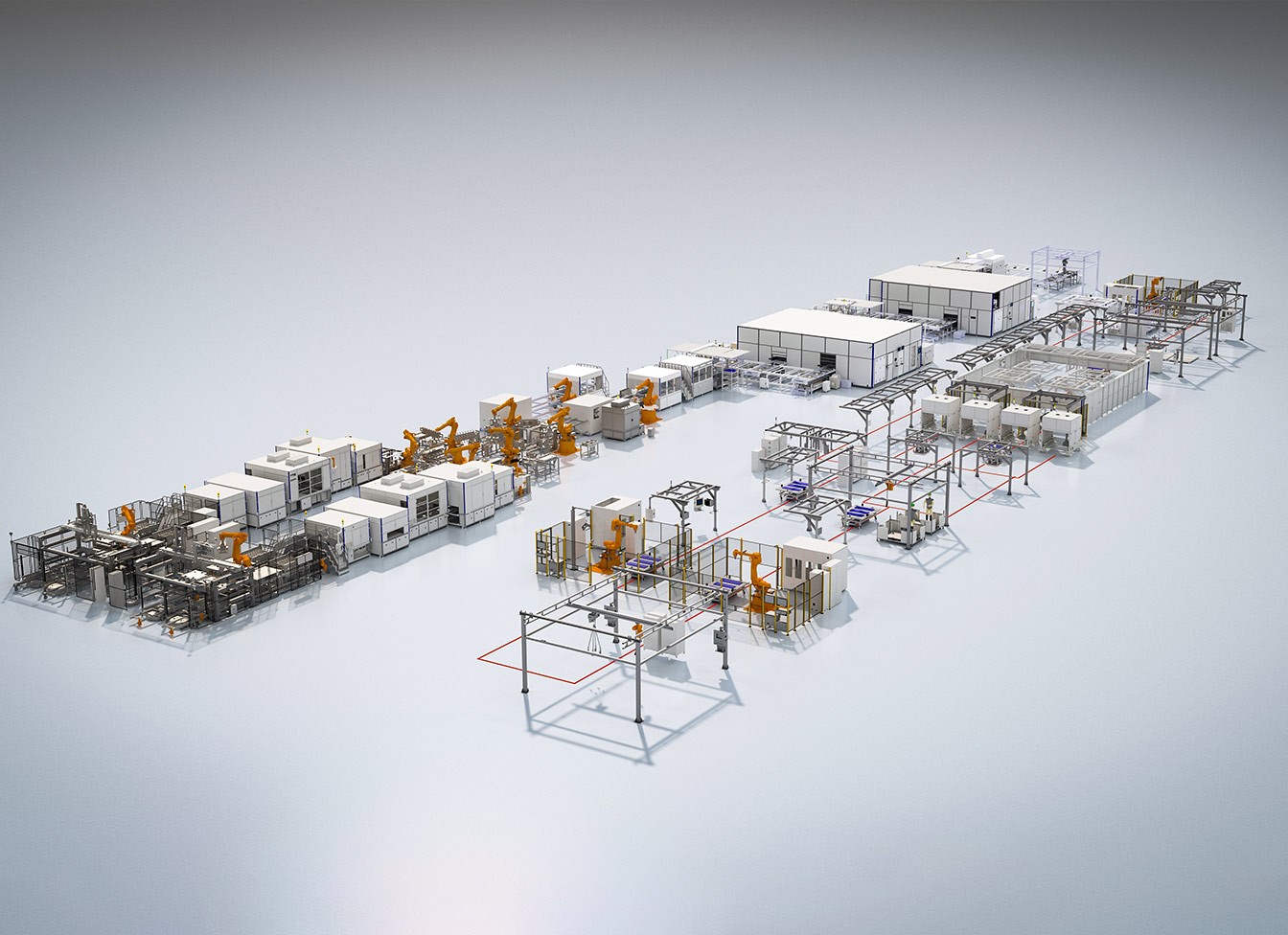
High-performance equipment becomes particularly valuable when multiple manufacturing activities need to operate in a coordinated sequence. A module or pack line, for example, may need to handle material frames, identify individual cells, test electrical characteristics, apply adhesives, inspect bonding, and separate nonconforming products before stacking. Automating these interactions can reduce unnecessary manual transfers and create a more consistent production rhythm.
FHS has developed a blade-battery module/pack production line around this type of workflow. Material frames are automatically unloaded and stacked, while AGVs support material transportation. CCD imaging calculates cell positions so robots can pick cells accurately, followed by barcode scanning, OCV testing, NG-cell replacement, gluing, aerogel application, visual inspection, and automatic rejection before qualified cells proceed to block stacking. These functions show how equipment investment can be assessed according to the number and complexity of processes it integrates rather than the number of machines installed.
The same principle applies further upstream. Effective battery cell manufacturing equipment should contribute measurable value through its intended process: higher throughput, controlled handling, better inspection, or reduced repetitive labor. The specific benefit depends on the manufacturing stage, so performance claims should always be connected to a clearly defined production requirement.
Flexibility Can Change the Investment Equation
Battery products do not remain fixed indefinitely. Cell dimensions, pack architectures, cooling structures, and production volumes can change as manufacturers introduce new products. A line that performs well today may become restrictive if its tooling, transport system, or control architecture cannot accommodate reasonable modifications.
Flexible equipment can therefore have economic value even if its benefits are not immediately visible in the first production run. FHS's FTS-MT, for example, provides ±0.01 mm repetitive positioning accuracy, a 5–40 kg single-mover load range, up to 847 N of thrust, and a maximum speed of 5 m/s. Its design supports quick mover and tooling replacement, modular expansion, and different workstation configurations.
That flexibility is relevant when evaluating battery pack assembly suppliers because the supplier's value extends beyond the initial delivery. A system capable of supporting product iterations may reduce the amount of equipment redesign required when production conditions change. The right question is therefore not simply whether a flexible system costs more, but whether that flexibility has a realistic use case within the factory's expected product roadmap.
Measuring the Investment Through Production Data
Automation becomes easier to evaluate when its performance can be measured. Production data can reveal equipment utilization, process cycle times, inspection results, downtime patterns, and product traceability information. These records allow manufacturers to compare actual operating conditions against the assumptions used during procurement.
At FHS, we also consider the relationship between physical equipment and digital production management. Our self-developed MES system supports closed-loop process monitoring and traceability and can integrate with a factory's existing MES. This gives production teams a way to connect process information across different stations instead of treating each machine as an isolated source of data.
For battery cell manufacturing equipment, traceability can be especially useful when a quality issue requires investigation. Cell identification, inspection records, and process information can provide engineers with a clearer production history. The resulting value is not limited to detecting defects; the information can also support process analysis and equipment improvement.
When Does the Investment Make Sense?
There is no universal threshold at which expensive equipment automatically becomes worthwhile. A high-volume factory with strict quality requirements may benefit significantly from automated inspection, precise positioning, and integrated material handling. A smaller operation with stable products and modest output may place greater emphasis on simpler equipment and lower capital expenditure.
The calculation should include the expected production horizon. If a line will operate for many years and handle several product generations, flexibility and maintainability may deserve more weight. Conversely, a short-term project with a narrowly defined product may not justify extensive modular capabilities.
Our experience at FHS is that equipment selection works best when production requirements are translated into measurable technical and commercial criteria. Through our work in new-energy automation, we cover applications ranging from cell production to module and pack assembly, with flexible transport, inspection, testing, and assembly technologies forming part of the broader manufacturing architecture.
Judge Equipment by Its Lifetime Contribution
High-performance manufacturing equipment is worth the investment when its additional capabilities create meaningful value throughout the production lifecycle. The calculation should account for more than initial purchase cost: stable throughput, process control, labor requirements, traceability, maintenance, changeover, and product evolution can all affect the eventual return.
At FHS, we approach battery pack assembly suppliers from a system perspective, considering how equipment functions interact within the actual production process. For manufacturers evaluating capital-intensive automation, the strongest investment case is not necessarily the machine with the longest specification list. It is the solution whose technical capabilities correspond closely with production goals and continue to provide practical value as the factory develops.

Public Relations Officer
Miss Zeng
 info@ksfhs.com