Technical Sharing
2026/09/21
Blade Battery Technology: Structure, Assembly, and Production Requirements
21
2026/09/
Long, flat battery cells have changed the way engineers think about pack architecture. Rather than treating every cell as a small unit that must first be grouped into conventional modules, a blade-style design can use elongated cells arranged efficiently within the pack structure. BYD describes its Blade Battery as an LFP-based design with a long, flat form factor and a honeycomb-like structural arrangement, emphasizing packaging efficiency and mechanical strength. For manufacturers, understanding blade battery technology therefore requires looking beyond cell shape to the relationship between cell design, pack structure, assembly processes, and production equipment. At FHS, we approach these requirements from the manufacturing side, where precise handling and controlled assembly become especially important.
What Defines a Blade Battery?
The term “blade” primarily refers to the elongated, flat geometry of the cell. Compared with more conventional block-shaped cell arrangements, this format allows cells to be placed in an array with less unused space between individual units. BYD states that its design can increase battery-pack space utilization by more than 50% compared with conventional lithium iron phosphate block battery packs.
Chemistry is another important part of the concept. BYD identifies lithium iron phosphate, or LFP, as the chemistry used in its Blade Battery. LFP has different thermal and material characteristics from nickel-based chemistries, so the cell design and pack architecture need to be considered together rather than evaluated separately.
The result is a battery architecture in which cell geometry becomes closely connected with pack-level engineering. The cells are not simply made longer for appearance; their dimensions, arrangement, cooling strategy, electrical connections, and structural integration all affect how the finished battery is assembled.
How Cell Geometry Changes Pack Assembly
Long cells introduce different handling requirements during manufacturing. A production system must move elongated components without unwanted rotation or spacing errors, while subsequent operations may require accurate positioning before bonding, welding, inspection, or stacking. The longer form factor can therefore place greater emphasis on synchronized transport and positioning.
A typical automated process may begin with cells loaded in frames. Equipment can automatically unload and stack those frames, pick individual cells, adjust their spacing on a variable-pitch platform, and perform identification or electrical checks before assembly continues. These operations create a controlled sequence in which cell orientation and spacing are established before grouping.
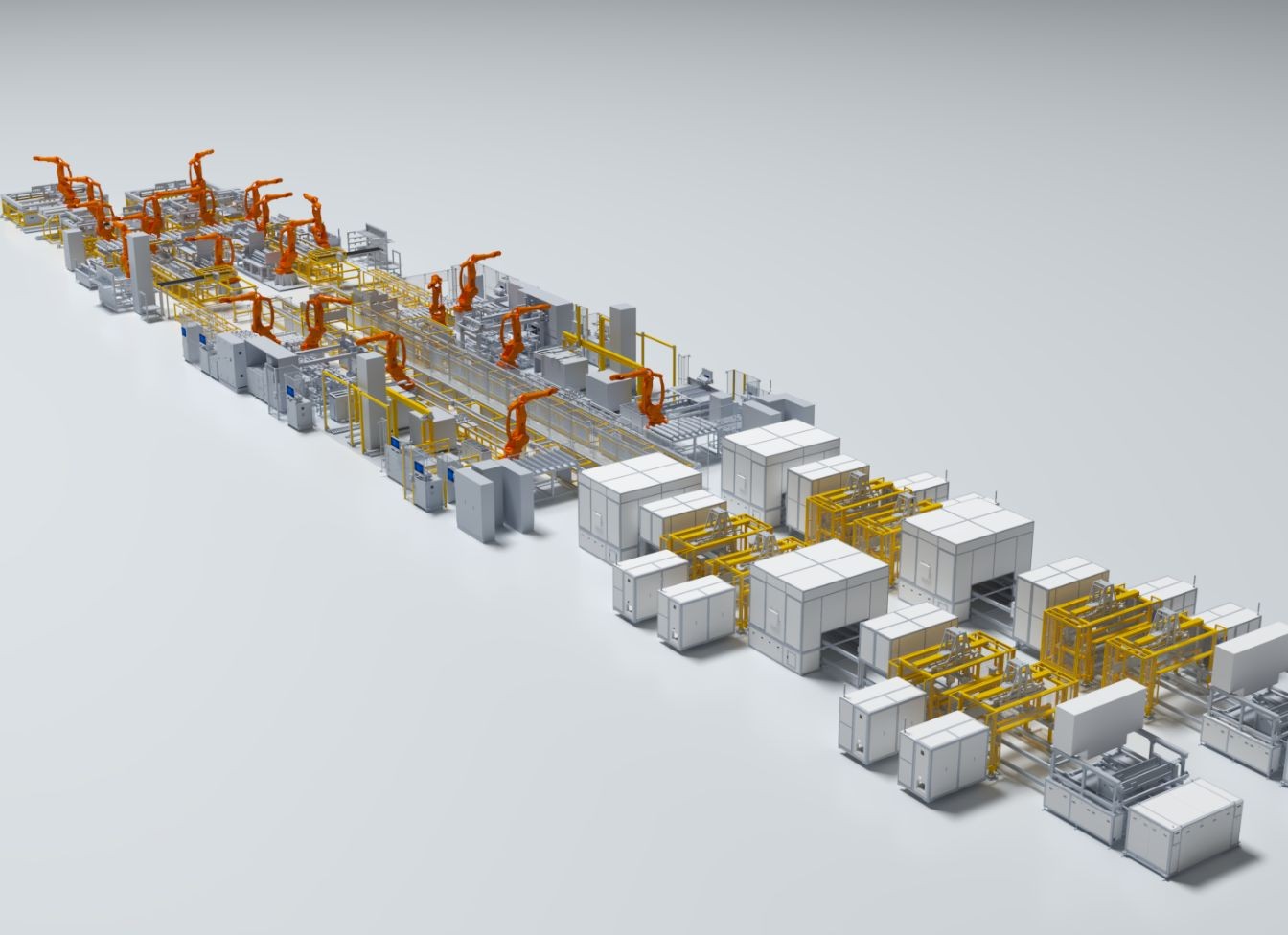
Our blade battery assembly line follows this type of process logic. The production concept includes automatic cell grabbing, variable-spacing deployment, scanning, OCV testing, defective-cell replacement, adhesive application for beam grouping, large-surface and water-cooled plate pasting, followed by cell stacking into smaller units and subsequent module formation. The important point is not simply automation at each station; the stages are arranged around the characteristics of elongated cells.
Why Precision Matters During Automated Assembly
A long cell can be sensitive to positioning errors because a small angular deviation may become more noticeable across its length. That makes accurate transfer and alignment important before operations such as adhesive application, grouping, and stacking. Automated positioning can provide a defined reference for each cell instead of relying on repeated manual adjustment.
Inspection also has a specific role in this architecture. OCV testing can identify electrical differences between cells, while scanning can associate a cell with its production information. If a defective cell is detected before grouping, the system can replace it before that component becomes part of a larger assembly.
FHS's lithium-battery applications include module assembly and stacking processes using flexible transport technology. One published module assembly case incorporates cell sorting and barcode scanning, OCV testing, glue application and inspection, beam assembly, water-pipe connection, and block stacking, while supporting cooling plates within a specified 800–1500 mm size range. This illustrates how the physical characteristics of the battery influence not only cell handling but also the equipment architecture around it.
Where Production Automation Fits Into the Process
A modern blade-style battery line needs to coordinate material movement, inspection, adhesive processes, stacking, and module formation. Each function has its own technical requirements, yet the production sequence depends on their timing and communication. A delay in cell preparation, for instance, can affect downstream grouping and stacking.
Flexible transport can help address some of these requirements by allowing individual movers to be controlled according to the production stage. FHS's FTS-MT provides repetitive positioning accuracy of ±0.01 mm, a single-mover load range of 5–40 kg, a maximum thrust of 847 N, and a maximum speed of 5 m/s. Its modular design also supports tooling replacement and different workstation configurations.
Such technology does not define the battery itself; instead, it provides infrastructure for handling the production process. That distinction matters because equipment should be selected according to cell dimensions, payload, cycle time, inspection requirements, and future product changes rather than assuming that one transport architecture fits every battery format.
From Cell Design to Finished Battery
The significance of blade battery technology becomes clearer when the entire manufacturing chain is considered. Cell geometry affects handling, handling affects positioning, positioning influences grouping and bonding, and those operations ultimately contribute to the structure of the finished module or pack. A successful production approach must therefore connect cell-level requirements with pack-level assembly.
Flexible production is also useful as battery designs evolve. FHS's new-energy portfolio covers CTP1.0, CTP2.0, CTP3.0, short-knife gap configurations, and gapless short-knife configurations, with actual production implementation and acceptance cases. This range reflects an industry in which battery architectures continue to develop rather than remaining fixed around one production model.
For manufacturers, the practical lesson is that battery design and production engineering cannot be treated as completely separate subjects. A change in cell geometry may affect transport, tooling, inspection, cooling-plate handling, adhesive application, or stacking logic, so equipment planning needs to account for those relationships from the beginning.
A Battery Format That Reshapes Manufacturing
A blade-style cell is more than a longer version of a conventional battery cell. Its geometry changes how cells can be arranged, how space is used inside a pack, and how manufacturers approach handling and assembly. BYD's published information connects the Blade Battery with LFP chemistry, elongated cell construction, improved pack space utilization, and structural considerations.
For us at FHS, blade battery assembly line design starts with those physical and process realities. Automated cell handling, variable spacing, testing, adhesive application, inspection, and stacking each solve a different manufacturing requirement, while flexible transport can connect them into a coordinated workflow. As battery architectures continue to evolve, understanding the relationship between cell design and production engineering will remain essential to building practical, adaptable manufacturing systems.

Public Relations Officer
Miss Zeng
 info@ksfhs.com