Company News
2026/07/28
From Semi-Automation to Full Automation | FHS Innovations Drive the Next Generation of Energy Storage Automation
28
2026/07/
As the global energy storage industry continues to expand rapidly, orders for utility-scale energy storage projects, commercial and industrial energy storage systems, and containerized solutions in overseas markets are rising steadily. The industry is entering a new phase of quality-led growth.
Yet significant automation gaps remain in battery module assembly and container integration, limiting throughput and consistent product quality. Two critical operations—fitting steel bands around battery modules and installing battery packs into container racks—have traditionally relied on manual assistance or semi-automated equipment combined with forklift-assisted alignment. In addition to high labor costs, variations in manual operation can disrupt cycle times and lead to inconsistent yield. These conventional semi-automated production models can no longer meet the energy storage industry's rapidly growing demand for volume production.
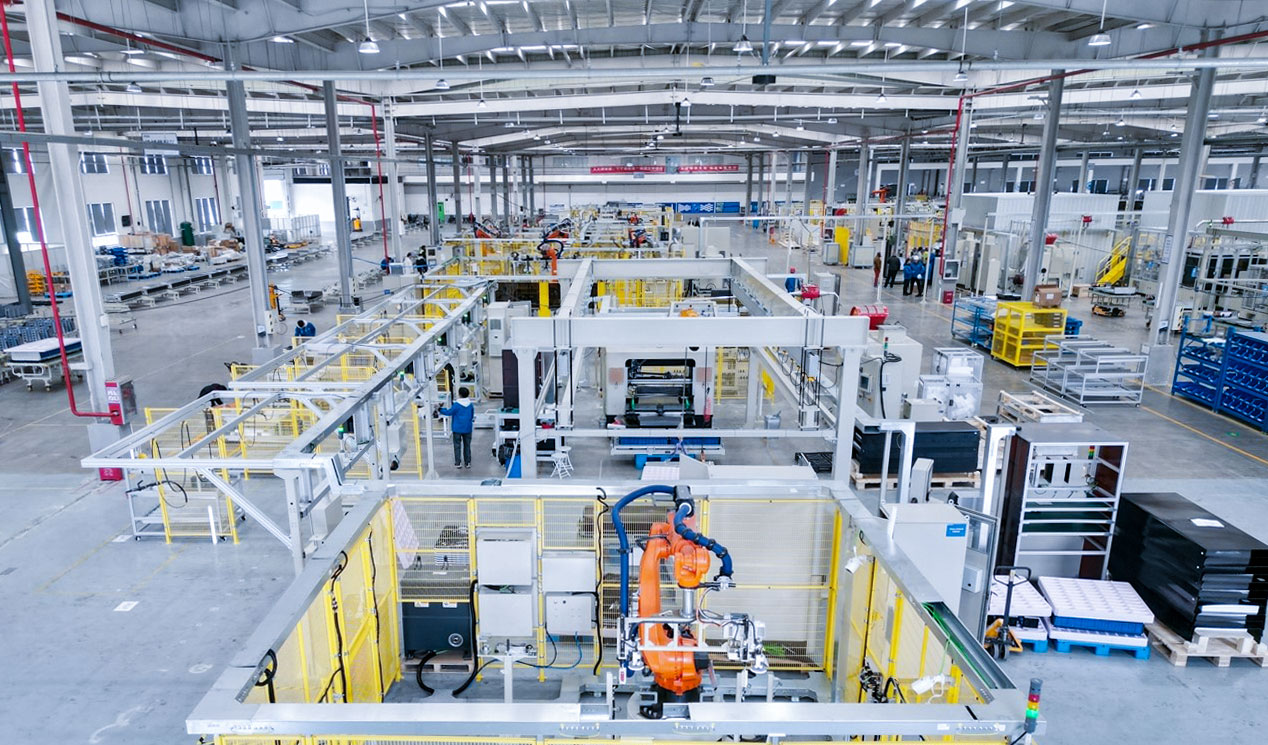
To address these industry-wide process challenges, FHS Group has drawn on its extensive production-line deployment experience and its ability to refine technologies for real-world manufacturing scenarios. The result is two proprietary solutions: a fully automated steel-band fitting system for energy storage modules and a dual-robot system for fully automated battery pack installation into containers. Together, these innovations close critical automation gaps in energy storage pack production and advance module, pack, and container integration toward full automation.
Fully Automated Steel-Band Fitting for Energy Storage Modules: More Than Triple the Throughput with Flexible Production
Steel-band fitting is a critical step in energy storage module assembly. It directly affects structural strength, assembly accuracy, and long-term operating stability, yet it has traditionally remained one of the most labor-intensive and least automated operations on the line. Early processes relied entirely on manual assembly, while later semi-automated solutions still required operators to assist with alignment, material replenishment, and verification. Common limitations included uneven compression, alignment deviations, and poor compatibility across cell configurations—constraints that made these solutions unsuitable for flexible, large-scale production.
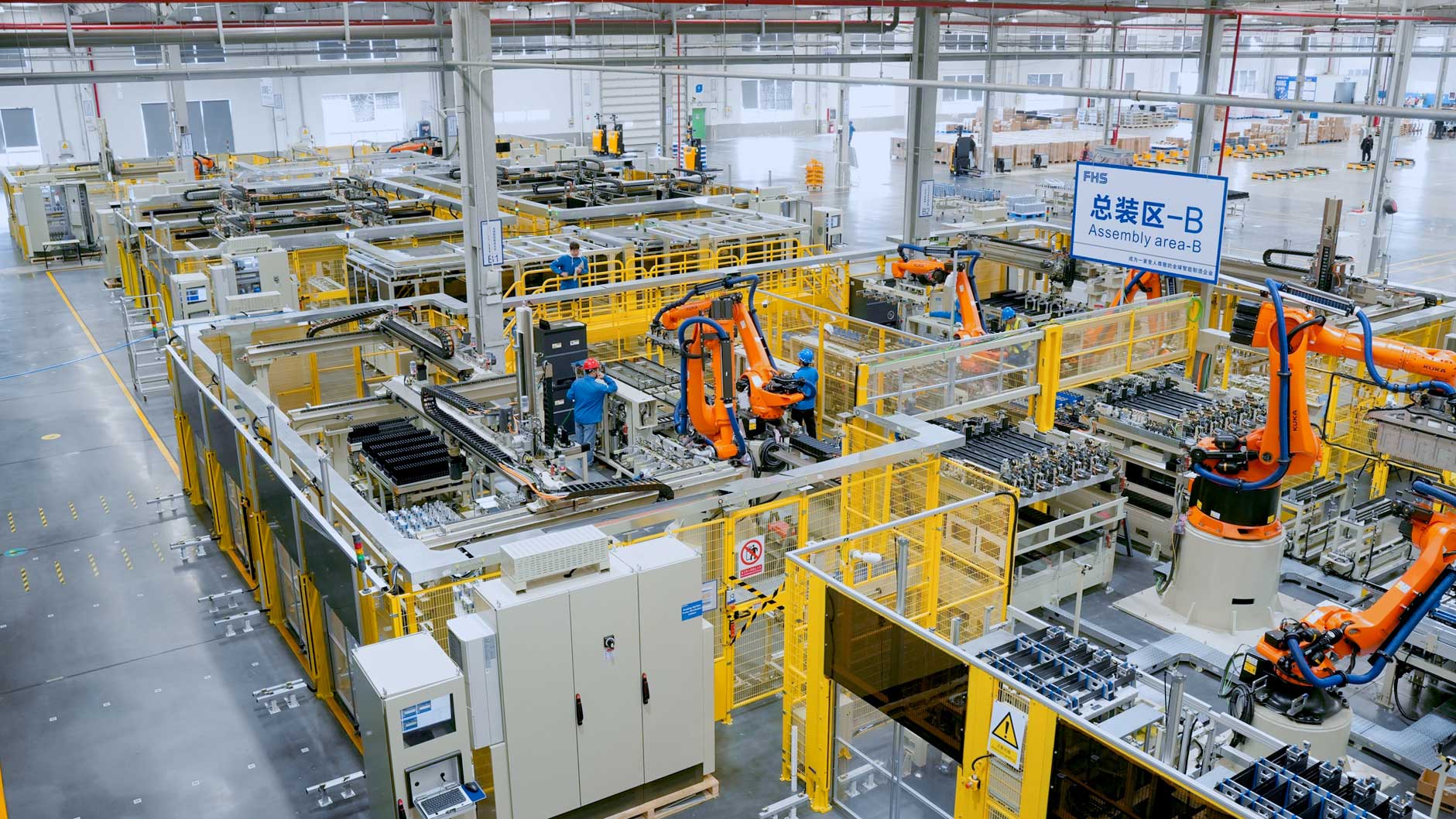
Through multiple rounds of process refinement and equipment optimization, the FHS technical team independently upgraded the entire operation from manual and semi-automated processing to full automation. The system integrates a servo press, a module compression-holding pallet, an automated steel-band feeding cart, a six-axis robot, and purpose-built steel-band gripping tooling to deliver a fully automated, closed-loop process.
A Redesigned System Architecture for Higher Throughput and Consistent Quality
By redesigning the underlying equipment architecture, the solution addresses the accuracy, efficiency, and adaptability limitations of conventional processes. A single module takes 90 seconds with a manual process and 45 seconds with a semi-automated process; the FHS fully automated process reduces this to 26 seconds. This more than triples throughput compared with manual operation while improving process consistency and moving beyond the capacity limits of manual and semi-automated production.
Flexible Design for Multiple Configurations and Customized Production
The system is designed for flexible production and allows easy switching between manual and automatic operating modes. With only a small number of change parts, it can accommodate modules with different cell counts and lengths, supporting multiple product variants and customized volume-production requirements.
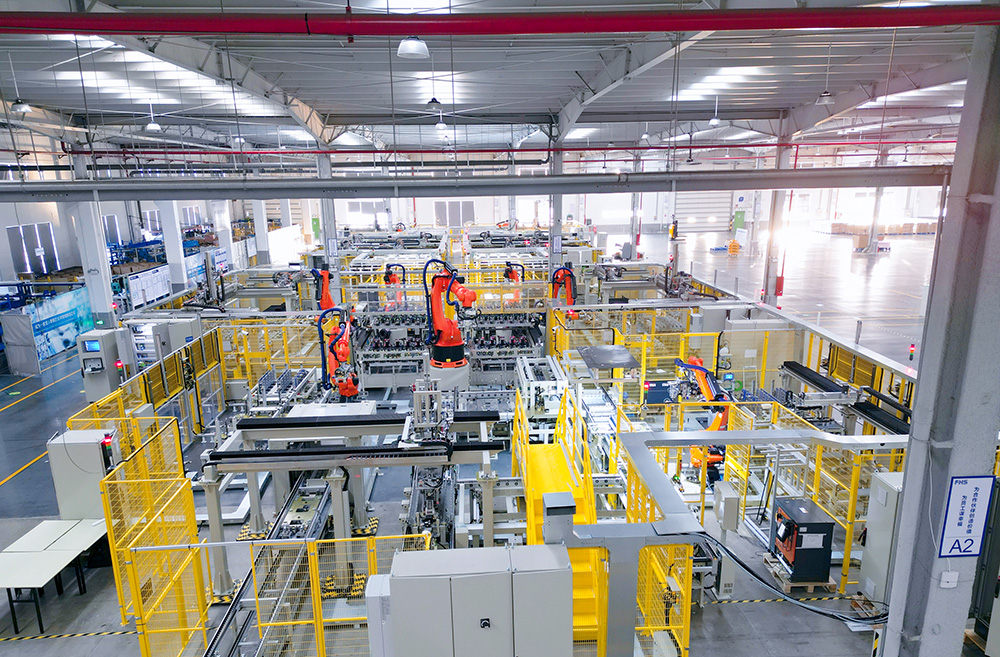
The solution is already operating on a volume-production line for a leading energy storage company in China. Following deployment, the station runs without direct operator involvement, helping the customer reduce labor requirements while improving throughput and product consistency.
Dual-Robot Automated Pack Installation: A High-Precision Solution for Intelligent Energy Storage System Integration
Installing battery packs into containers and tightening the associated fasteners are critical final steps in energy storage system integration—and among the most difficult to automate. Conventional semi-automated equipment cannot complete the full process independently and still relies on manual positioning, fine adjustments with a forklift, and follow-up tightening by operators. This extends the production cycle for each container and increases the risk of pack damage, missed fasteners, out-of-specification torque, and positioning errors.
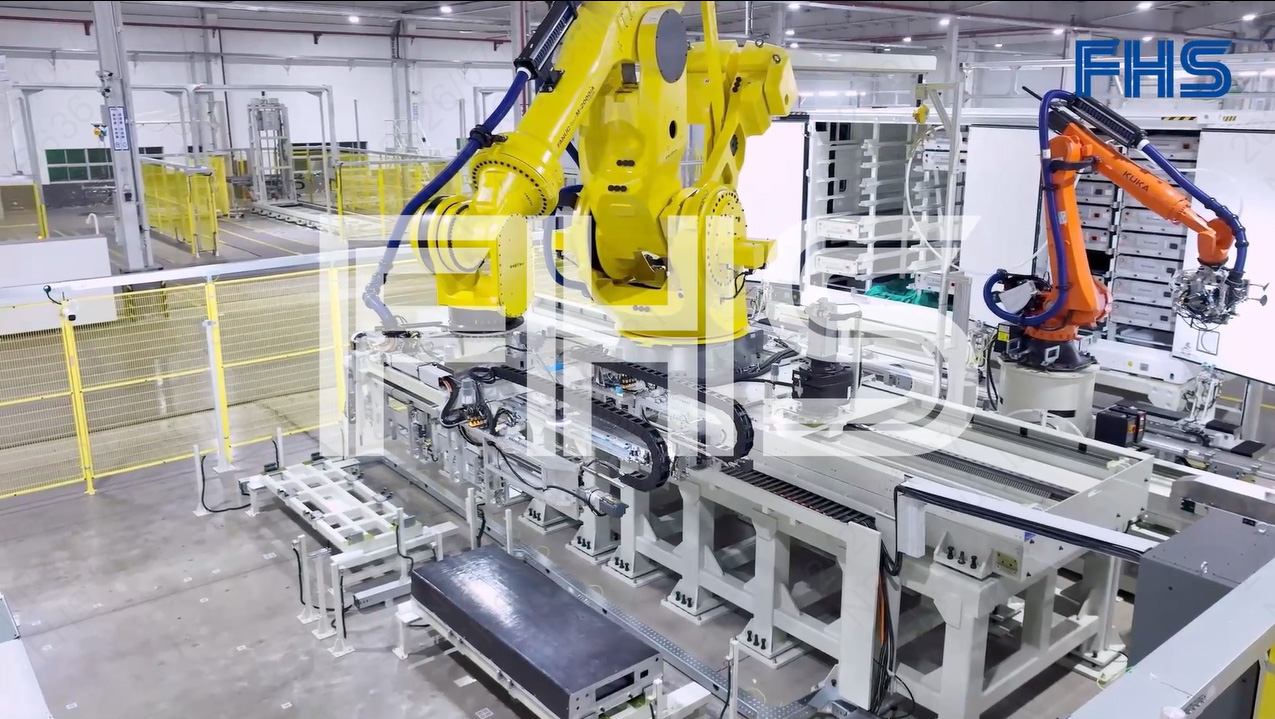
In response, FHS Group has introduced an industry-first dual-robot system for fully automated battery pack installation into containers. The integrated solution combines automatic door opening, precision positioning, flexible pack insertion, automatic fastener feeding, intelligent tightening, and end-to-end data traceability. Together, these capabilities form a closed-loop “sense–decide–act” workflow and represent an advanced approach to energy storage system integration.
Dual-Vision Coordination for High-Precision Operation
At the heart of the station are two high-payload industrial robots, each equipped with a seventh axis. The system combines 3D and 2D machine vision to achieve assembly accuracy of up to ±0.1 mm. The pack-installation robot uses an eye-in-hand 3D camera to map the container's internal rack structure, while a 2D camera identifies the precise pick-up position of each battery pack, helping prevent impacts and misalignment. The tightening robot scans the work area using 2D vision, locates each fastener, and performs standardized tightening with an intelligent force-controlled tightening tool. The two robots operate in parallel without operator intervention, enabling seamless coordination across the entire process.
Flexible, Digitalized Production for Greater Efficiency and Quality
The solution delivers clear benefits in both production efficiency and quality control. An adaptive flexible gripper accommodates multiple battery pack models, while deep integration with the manufacturing execution system (MES) enables automatic product changeovers, real-time production-data collection, and complete traceability of tightening torque. The entire process can therefore be monitored, traced, and controlled. The system reduces the time required for pack installation and tightening—from a multi-operator process to less than 2.5 hours per container—and can support annual production capacity at the 10 GWh scale. This improves volume-production efficiency and lowers operating costs while maintaining assembly accuracy and consistency across every unit.
The dual-robot solution has been deployed on a major benchmark containerized energy storage project in North America. Designed for overseas operations that demand high levels of automation, rigorous standards, and minimal maintenance, it supports stable, continuous 24/7 production. The system addresses persistent challenges at overseas sites, including labor shortages, inconsistent manual tightening, and a high risk of pack damage during installation. Its operating stability and volume-production efficiency have been validated through extended use at the customer's site.
Proprietary Innovation and Patented Technologies Advancing Energy Storage Automation
FHS Group's fully automated steel-band fitting system and dual-robot automated pack-installation system are proprietary, patent-protected technologies developed in-house. The relevant equipment has obtained applicable North American safety certification through a Nationally Recognized Testing Laboratory (NRTL), supporting safe, reliable operation and compliance in overseas markets. The core equipment, vision algorithms, coordinated control logic, and flexible adaptation systems were developed by the FHS technical team to address long-standing industry challenges, including automation bottlenecks, limited product adaptability, insufficient accuracy, and heavy reliance on manual labor.
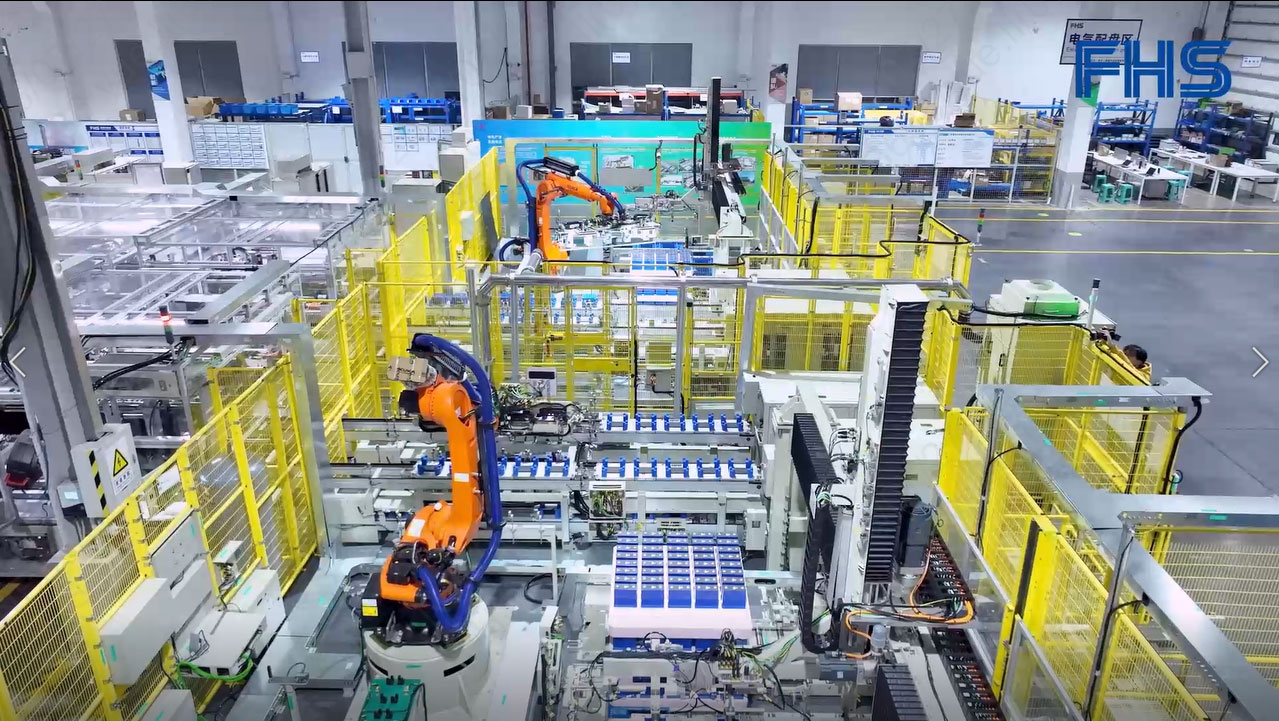
Through sustained innovation and proven project execution, FHS Group continues to strengthen its position in energy storage automation. Looking ahead, the Group will remain focused on intelligent and flexible manufacturing, refining its core technologies and solutions in response to market needs. By delivering more innovative, competitive, and reliable automated production lines to energy storage customers worldwide, FHS aims to support the industry's continued scale-up and quality-led growth—and to shape the next stage of new energy automation together with its partners.

Public Relations Officer
Miss Zeng
 info@ksfhs.com