Technical Sharing
2026/09/21
How EV Battery Production Shapes Long-Term Battery Performance?
21
2026/09/
A battery’s performance over time is influenced by much more than the chemistry inside its cells. Manufacturing conditions determine how accurately components are positioned, how consistently materials are joined, how defects are detected, and how tightly each process is controlled. For this reason, battery manufacturing automation has become an important part of discussions about long-term battery quality. The connection is particularly relevant to electric vehicles, where batteries are expected to deliver stable performance through repeated charging, discharging, temperature changes, and mechanical stress. At FHS, we view production quality as one of the foundations that can influence how a battery performs throughout its service life.
Manufacturing Quality Sets the Starting Point
Battery aging is a natural process, but the condition of a battery when it leaves the factory can influence how that aging develops. Variations in electrode alignment, welding quality, insulation, sealing, or cell assembly may introduce differences between products before they are placed into a vehicle.
A well-controlled production process addresses these variables through defined procedures and automated equipment. Sensors can monitor workpiece position, control systems can manage process sequences, and inspection equipment can identify deviations before products move further along the line. These functions do not stop aging, but they can reduce avoidable manufacturing variation.
The relationship becomes especially important in EV battery manufacturing, where battery packs contain many interconnected components. A small weakness in one connection may not produce an immediate failure, yet repeated electrical or thermal stress can make the underlying quality difference more significant during long-term use.
Welding Accuracy Can Affect Electrical Connections
Welding is one of the critical processes in battery production because electrical connections must carry current while remaining mechanically stable. Busbars, tabs, terminals, and other conductive components may require different welding approaches depending on their geometry and material.
An inconsistent weld can result from variations in positioning, energy input, material condition, or process timing. Automated welding systems can use predefined parameters and controlled positioning to reduce some of these variables. Inspection after welding provides another layer of information by identifying visible or measurable deviations before the battery moves to subsequent stages.
At FHS, we develop laser welding processes for applications such as busbars, prismatic batteries, cylindrical battery wires, and top caps. We also work with specialized flat-wire motor welding applications. The broader principle is that welding equipment needs to be matched to the component and production requirements rather than treated as a one-size-fits-all process.
Thermal and Mechanical Consistency Matter
Battery cells operate within environments where temperature and mechanical conditions can change repeatedly. During charging and discharging, cells generate heat and undergo physical changes. If components have inconsistent assembly conditions, these repeated stresses may affect products differently over time.
Manufacturing automation can contribute to consistency by controlling assembly force, component positioning, process timing, and inspection criteria. Quality information can also be associated with individual products, giving engineers a clearer record of how each unit passed through production.
Our work at FHS combines equipment control with inspection and digital manufacturing capabilities. MES integration, vision systems, process monitoring, and traceability can provide information that helps production teams investigate abnormal results. Such systems are particularly useful when many process stages contribute to the final condition of a battery.
Why Traceability Matters During Battery Life
Long-term performance cannot be judged entirely from the finished appearance of a battery. If a problem emerges after months or years of operation, engineers may need to understand how the affected product was manufactured. Traceability provides a route back through that history.
A connected production system can associate a battery with its production batch, equipment, inspection results, and relevant process information. If a pattern appears in field data, manufacturers can compare affected units with other products and investigate whether they share a particular production condition.
At FHS, our self-developed MES system provides closed-loop monitoring and traceability throughout the production process and can integrate with a factory's existing MES. This approach allows production information to remain connected rather than being stored as isolated records, giving engineering teams more context when quality questions arise.
Automation Supports More Consistent EV Battery Production
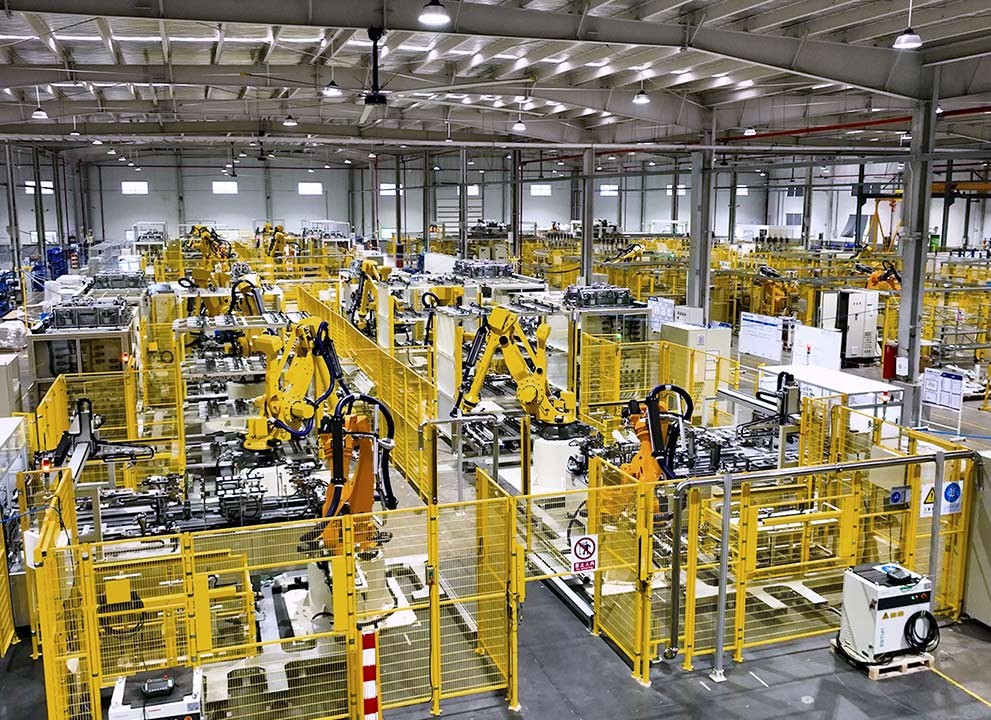
A modern battery line involves numerous operations, from material preparation and cell assembly to welding, inspection, testing, and module or pack production. Each stage can influence the next, which means quality management cannot focus on one workstation alone.
For EV battery manufacturing, automation becomes valuable when these stages operate as a coordinated system. Material handling can follow defined routes, process parameters can be controlled electronically, and inspection results can be associated with individual products. This creates a more structured production environment in which deviations can be detected and investigated earlier.
FHS provides intelligent manufacturing solutions for power-battery production lines, with experience covering different battery architectures and production requirements. Our production-line portfolio includes CTP1.0, CTP2.0, and CTP3.0, as well as short-knife gap and gapless short-knife configurations, with actual production implementation and acceptance cases. The specific configuration depends on the battery design and manufacturing process rather than one universal line concept.
Production Quality Influences the Starting Point for Battery Life
Battery performance over time is shaped by chemistry, operating conditions, charging behavior, temperature, and many other factors. Manufacturing cannot determine every aspect of that future performance, but it can influence the quality and consistency of the product entering service. Accurate assembly, stable welding, controlled processes, effective inspection, and traceable production data all contribute to that foundation.
At FHS, we regard battery manufacturing automation as a way to bring these production activities into a more controlled and connected framework. Our focus is not simply on automating individual operations; we consider how equipment, quality control, data, and process management interact across the production line. For electric-vehicle batteries, that systems-level perspective provides a practical route toward more consistent manufacturing quality and a stronger starting point for long-term performance.

Public Relations Officer
Miss Zeng
 info@ksfhs.com